
Stories from the Blackbelt
ABOUT THE AUTHOR
Dr. Pam C. Delaine is an author and publisher at 1 Vision Empowerment Publishing. She writes to share, inspire, encourage and motivate. With the Pen It Series, Volumes I thru III, she intends to inspire the sharing of family and community history. “Everyone has a story,” she says, “so everyone can find themselves somewhere in these pages.” From her studio in York, Alabama, Dr. Delaine assists other writers who desire to self-publish and continues to gather stories from the Blackbelt.
EXCERPT FROM
Stories from the Blackbelt
BY PAM C. DELAINE
©2025. ALL RIGHTS RESERVED.


Introduction
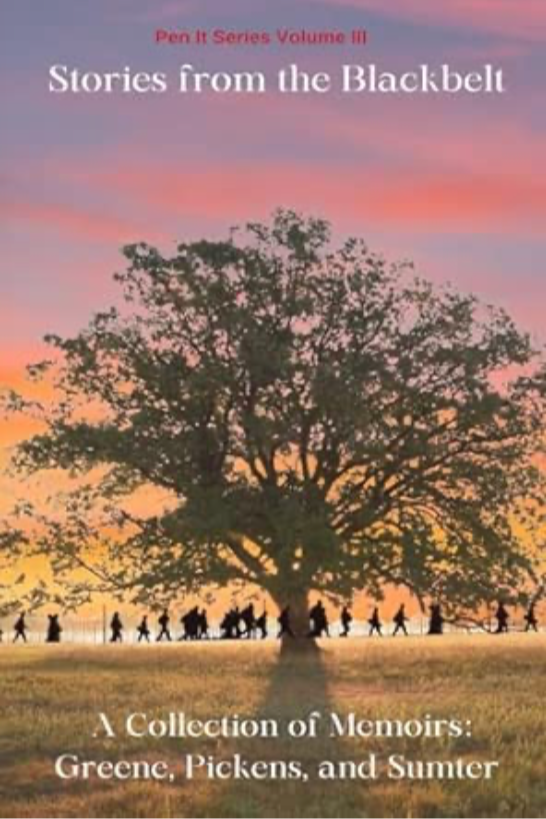
There is a quiet power in sharing your story, especially when those stories come from the heart of places often left out of the spotlight. This book, the third in our ongoing anthology series, centers on voices from Alabama’s Blackbelt, a region rich in history, culture, and deeply rooted community. With this volume, we begin our journey by highlighting stories from Alabama’s Greene, Pickens, and Sumter counties, each one offering a glimpse into the soul of a place shaped by strength.
The Blackbelt is a living legacy. It is the land, the people, the past that still speaks, and the future being shaped by those who remain. Through these pages, you’ll hear firsthand accounts of life in the region, fun times, tradition, family, hope, and resilience told by those who know it best.
This collection is only the beginning of the Blackbelt series, but the third in the Pen It volumes. My goal is to continue gathering voices from the past. Each story adds a layer to the truth of times, where we come from, and what connects us.
Whether you’re from the Blackbelt or just discovering its depth for the first time, I invite you to read with openness and care. Let these stories speak to you, inspire you, and remind you of the beauty that lies in every community and the history of every landmark mentioned.
This collaboration seeks to remind us of the richness found in the Blackbelt. The first three featured counties are neighboring counties, so the citizens are friends or may be related to each other. That’s the tie that binds many in the Blackbelt: family and community.
Pam C. Delaine, Visionary Author

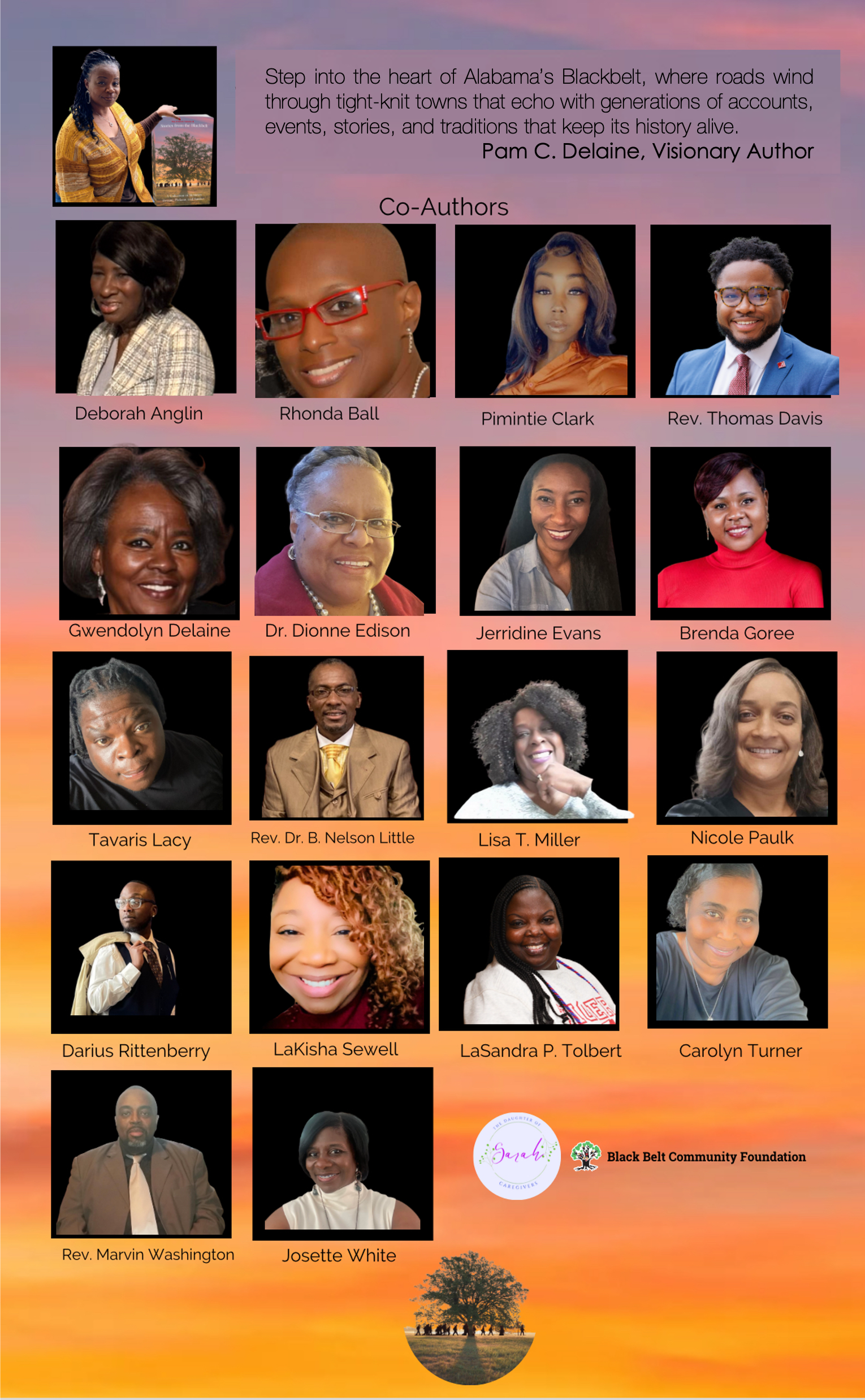

Meet Dr. Dionne H. Edison – Greene County, Alabama
I am not a native of Greene County, Alabama. I moved there from Tuscaloosa, Alabama. I am also not from Tuscaloosa. Tuscaloosa was a way station on my journey to Greene County from Talladega, Alabama, where my parents met while attending Talladega College. After moving, I discovered I was connected to Greene County on my family tree and through the Civil Rights Movement. Coming here changed the trajectory of my life.
I ended up in Tuscaloosa while resisting the path God was showing me. Even in defiance, I'd pray. A childhood experience taught me to pray even when I was in a mess of my own doing.
Moving to Greene County was like going to visit distant aunts, uncles, and cousins I knew nothing about. I could feel people looking at me and my six-year-old son. I could hear the questions: Who is she? Where is she from? Why is she here? However, they came to my aid on all fronts. I will never forget.
As children are prone to do, my sister and I got into a fair share of mischief. We would climb Grandma’s mango trees and chase the chickens. One afternoon, we used Granddaddy's truck as a jungle gym. We were out there a long time, climbing and jumping. At dusk, my sister jumped off the truck and began to scream in a manner so terrifying that I momentarily could not react. Frozen, I turned to see her writhing in pain, holding her right arm that looked disjointed, if not broken. Grandma ran out, looked at the two of us, hollered for Granddaddy, grabbed her up, got in the truck, and they drove off. They left me behind. I was scared she was going to die, and I was responsible. She was mine to take care of.
My grandparents took her to the church about three blocks away from their house. They took her to that God named Jesus, whom I couldn't see. They were gone for a long, long time. When they returned, I couldn’t see my sister until Grandma got to the porch. Thankfully, my sister was smiling. That disjointed arm was straight, and she was not in pain. I asked her, “What did they do?”
She said, “They laid me down and talked over me. They talked for a long time.” I witnessed a miracle. That miracle made trusting God, whom I cannot see, real. That happened over 50 years ago. My sister has never complained of any aches and pains concerning that arm. She has never gone to a doctor about it. She has never had it x-rayed. No need. The Divine intervention was complete.
Do you think I believe in miracles? Do you think I believe God exists? Do you think I believe Jesus is God in the flesh who walked this earth to save mankind? I don't think. I know. Every day, I'm excitedly fascinated to witness God in action.
My life was messed up. I was a single mom, struggling, and soon to be homeless because my summer job was ending, and I didn't have enough funds to pay another month's rent. All I could do was pray. Sometimes I was so weary I could only sigh. God sent me to Greene County. God answers prayers.
I became a teacher. I worked with people from babies through the elderly. I worked in general education, special education, teacher education. Former students often stop to thank me. I did something right. My family has grown from just the two of us to span three generations.
A child’s faith rooted in His word saved me from myself. God didn't just smile on me. He kept me. Trust Him. Believe it or not, He has you, too.
Meet Mr. Tavaris Lacy – Pickens County, Alabama
Growing up in my family was definitely an unforgettable experience. I got a chance to see the good, the bad, and the ugly. Somehow the good outweighed the bad.
I can remember the love from my parents. There were two different styles but, hey—no judgement.
The tough love from my oldest brother and the bullying can take place in your neighborhood as long as you let it.
My family really didn’t have many traditions. However, family get-togethers were definitely one for the ages. There’s no love like family love.
In my city, people hung out on the courthouse stoop and at the Jr. Food Mart Store in Carrollton, Alabama. I have witnessed various situations at other locations and wouldn’t change it at all.
My school was like none other. The atmosphere was different. It was something about hearing that Tomahawk anthem. I got chosen to be prom king, cheerleader sweetheart, and #6 in my class, and an overall good kid.
Meet Rev. Dr. Bob N. Little – Sumter County, Alabama
I was raised in Panola, born and bred. I went to junior high school at North Sumter Jr. High School and went on to graduate from Sumter County High School. I’m a native of Sumter County and God sent us back 25 years ago to do ministry in Panola, Alabama.
I was a part of the nationally renowned Mighty Marching Hornets band of Alabama State in the percussion section and a member of Kappa Kappa Psi Band Fraternity for those who are trying to build better bands. Additionally, I am a member of Phi Beta Sigma Fraternity Incorporated, International where we are doing things globally and have chapters around the globe. We are still doing what our motto told us to do: Culture for service and service for humanity, to be able to help elevate and enlighten those we come in contact with to help them be better humans for the human race.
In the Blackbelt we have challenges. And because we have challenges, we need to make the right decisions so that we can prosper in the Blackbelt. If anyone would notice the dynamics of how industry is operated in Alabama you would notice that going north towards Tuscaloosa, Birmingham, and Huntsville it is prospering. Going south, through Leroy and Mobile, it is prospering. The only city that is prospering in the Blackbelt is the capital city of Montgomery, Alabama. But the corridor, other than that, is in denial, diminished, and being depleted. So, what we have to do is tell our story and let people know that these areas are in need. And if Alabama truly wants to be Alabama the Beautiful then they have to do something to help upbuild and bring prosperity to the Blackbelt.
Meet Lisa T. Miller – Sumter County, Alabama
As a child relocating from a big city such as Pittsburgh, PA to a little town called York, located in Sumter County, Alabama, it was a real culture change. It started in a little community outside the city limits where you could see but not understand the ethnic divisions, where the White kids went to school. Also, no Blacks were allowed for any reason. The elderly were still saying, “Yes, sir” and “No, sir” to certain people for fear of something happening.
Outside of that, the community was surrounded with loving, caring people, who accepted me and my family as one of their own. After several months in the country, we got our own place up Highway 17, on top of a hill, where I met my first family of friends, the Scotts/Bell family. After a brief stay there, we moved to a more stable place in Green Acres, where it all began.
The neighborhood was very family oriented, everybody looked out for each other, and parents of the neighborhood were allowed to discipline you with your parent’s permission. It has totally changed throughout the years—the kids, the parents, and the community itself.
The most important family tradition that came from my family was having morals and respect of others, especially the elders.
I can remember a Gulf gas station where the Bank of York presently sits, a Rexall drug store, TWL Store, Kellam Groceries, IGA, Clover Farm, Family Fashion, York Drug Store, Soul City Record Shack, Haney Ford, 5 & 10, York Library, York Cleaners, Mr. Finch Barber Shop, Delaine’s Beauty Shop, Johnnie Clark’s Groceries, York Laundromat, Peppa’s Restaurant, Greyhound Bus Station, and so many more, just to name a few.
Meet Rev. T. L. Davis – Sumter County, Alabama
Growing up in the small town of Emelle was one of the most humble, yet rewarding experiences. I vividly remember living in what our family called “The Blue House.” It was me, my mother, my sister, and my two nephews. My niece was born about four years later. It wasn’t the best of conditions, but we knew that we were loved, and to a bunch of kids, that’s really all that mattered. My mother and I slept on the couches in the living room, while my sister had a room to herself and my nephews had a bunk bed in another room; eventually, we converted a space by the one bathroom we had into a room for me.
Our neighborhood was full of love. Everybody knew everybody. I think we got the “tail end” of chastisement at anybody’s home. If we were cutting up at somebody’s house, not only were our folks going to find out about it, but we were going to get tore up wherever we cut up! Nonetheless, I wouldn’t trade my experience for anything. Our small community was and still is very family oriented.
For us in Emelle, the park was EVERYTHING! It’s where the kids gathered to play. It’s where the men gathered on Sundays after church to play basketball until dark. It’s where we met during the summer for the “Feeding Program.” The park was everything to us. There are so many experiences I think about when it comes to that monument.
One of the disadvantages of living in a small town is that our school was not in town, so we had to travel a moderate distance just to get an education. Livingston was about 15-20 minutes southeast of Emelle, but when you are riding on the school bus, it took, at a minimum, at least an hour to get to school, because one bus was picking up students at multiple stops.
Copies of Stories from the Blackbelt may be purchased by visiting, https://a.co/d/9uKO3yX.