
The Charm: Artistically Speaking
The Newest Installation of
For the Love of Literature
BY KHADIJA POUNSEL
COPYRIGHT 2026. ALL RIGHTS RESERVED.
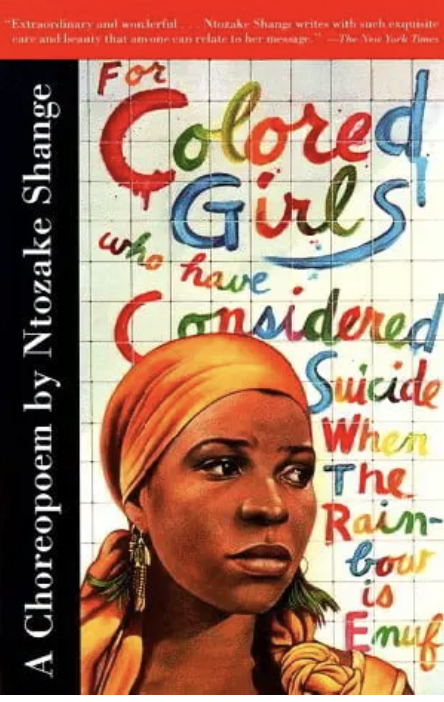
We met in high school. A dear friend introduced us. It was thin, lightweight, portable, with a unique title: for colored girls who have considered suicide/when the rainbow is enuf. I read it alongside my school assignments. One phrase in it was a stunner to me, time capsule worthy: “i found god in myself & i loved her…” (63). When I read those words for the first time, it was like my soul looked up from what it was doing. Over the years, I picked up the award-winning classic again and again.
As I considered the Art & Artist theme of this issue of KIZA BlackLit, Shange’s choreopoem came to mind and I wondered what light it could shed. My notes looked something like this:
Theme: Art & Artist
expression, lifestyle, purpose of art, media/mediums, struggles & triumphs, community & culture
-- expression: (self-evident)
-- lifestyle: (no singular lifestyle, only that you art)
-- purpose of art: (varies)
for colored girls:
-- media/mediums: (genre: choreopoem)
-- struggles & triumphs: (poems themselves, revelation)
-- community & culture: (performance piece, community-theatre roots?)
But then my thoughts sat down on a place—Power. My notes continued something like this:
Thoughts on Power: make move and shake, say “do this do that,” influence, enforce or effect, maintain or defy convention
First, that Art & Artist involved expression was clear to me, but where was the power? I asked myself. I quieted the music playing. Then I saw plainly, there in self-evident. Proof, identity, even proof of identity: I am X, you are Y or not, here’s what happened or didn’t, this means Z or doesn’t. Identity was crystal clear in for colored girls as lady in red, lady in orange, lady in yellow, lady in green, lady in blue, lady in brown, lady in purple delivered her own distinct story. Power? In narrative management.
Next, Shange was a poet-educator, the original cast of for colored girls were artists from various disciplines and the play went on to be performed independently by ensembles, both professional and amateur. Power? In iteration.
Finally, what about convention? I wondered. When I first read for colored girls, I was high school age. Next to all the other texts I read, it stood out because it was written in lower case, which bent my mind. The why behind that choice, the significance, the permissions it opened. I can’t fully capture the imprint that left. Power? In freedom.
Staying power, power period—that’s the magic of for colored girls, the charm of Art & Artist.
Loving Literature,
Khadija Pounsel