
Doing Crazy Stuff: Riding the Waters from Fear to Freedom
THE NEWEST INSTALLATION OF
Treasures of the African Diaspora
BY ZAKIYYAH ALI
COPYRIGHT 2026. ALL RIGHTS RESERVED.
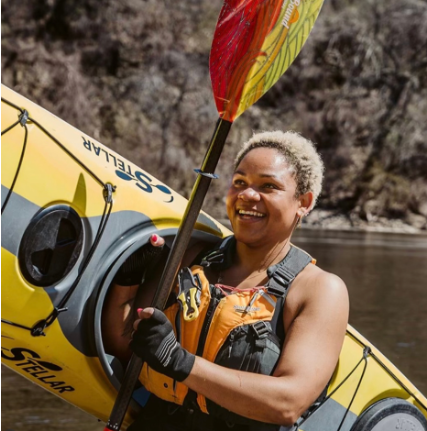
Preparing to paddle. Click the pic to see “Mother Water,” Devin Brown’s amazing story on film.
Alabama is an amazing state when it comes to environmental beauty. Areas abound with natural features, from wildlife, rivers, lakes and beaver ponds to forest and swamp lands. On one of my recent outings, I was invited to a most enchanted space known as The Elements. The name comes from the seasonal activities that the venue provides. The event that I attended featured clay harvesting and kayaking for wild clay from the riverbank. Meeting people and families from different places is always exciting, and this time was even more so than usual. Our hostess was very knowledgeable and prepared with laughs, food, warm throws, junk journals and so much more to share as we all unpacked and settled in for the next few days together.
Who knew I would meet my next Treasure of the African Diaspora at this enchanted location? This treasure has changed my thinking and soon—my actions. I want to introduce all of you to Devin Brown from the Twin Cities area—Minneapolis by way of New Jersey, her home state. Devin granted me a wonderful interview that I want to share with you.
So, doing crazy stuff. Ms. Brown, how and why did you pick up this mantle of doing crazy stuff? And let's define what this crazy stuff is that you do.
Devin Brown: Sure. I am an ultra endurance kayaker. I have been paddling since I was a kid. When I went to summer camp, I would just kick it around the lake, because I didn’t like swimming in the lake. As an adult, I went back to my old summer camp as an adventure trip leader, where I spent four weeks out of the summer island-hopping through the Gulf of Maine. And that’s where I fell in love—or I became aware that I really loved water and kayaking. Just the way it warms my soul, the way I feel in my body, the things that I get to see while I'm on the water. Yeah, just—I knew that paddling was essential to my mental health and I also knew that nature was also very critical to who I am and my mental health as well.
So now this this would lead me to think that you're also a strong swimmer.
Devin Brown: I can swim. When I was getting ready for my Mississippi River paddle in 2024 ,I made sure that I was able swim a mile. At the widest point of the Mississippi River, she's 11 miles wide. So, I really wanted to make sure I could swim a mile to get back to shore, just in case I capsized.
Zakiyyah Ali: Wow. As I listened to your YouTube, I was impressed with your knowledge of geography and the geographic movements. You talked about going through a narrow mountainous area and you had to navigate through that. In another instance ,you spoke about going through—what was it—a lake inside a lake or island with a lake inside? Do you prepare and read to understand the terrain of the environment where you’re going to paddle?
Devin Brown: As far as research is concerned, I'm so much more of an experiential learner. I will read if someone's like, you need to read this article, but being in Minnesota, I have a lot of Mississippi River rats surrounding me. There is a really vibrant community that goes along the river called the Mississippi River Angels. A lot of long trails have angel networks of supporters that help people that are crazy enough to do a source-to-sea paddle or hike the Appalachian Trail or the Pacific coast trail and things like that. These people are really the knowledge bearers and sort of tell you what you have already experienced, or what you're about to see after you leave their homes. The River Angels are just committed to understanding who the river is and her energies and what she has to offer, and they're very happy to share that knowledge.
The lake with the lake is Cass Lake, which is the second open water crossing on the Mississippi. Cass Lake has something called Star Island in it, and there is a lake in the center of the island. I think there's only like two or three of those that exist in the entire world.
Zakiyyah Ali: So, it's a natural wonder.
Devin Brown: Well yeah, it’s a natural wonder. I like I learned that from my first set of River Angels when I got out of the high waters.
Zakiyyah Ali: When we met, you talked about how, as an African American woman, you were happily able to pave the way to paddling and engagement with nature, and you were also grateful to all the people who helped. It reality, it wasn't always the safest thing. Can you kind of talk a little bit about that and why that’s important.
Devin Brown: Yeah, I would say that I was very fortunate to not have experienced overt racism until into my early 30s, as I was paddling down the Mississippi River. I got called the n-word, with my kids in the car. Somebody goes, “Oh look, there's an n” as I was paddling down the river, doing the Mississippi River races. That really ignited something in me, because it was very obvious that I was the only Black person, especially the only Black woman that was out there doing this thing and embracing the water in the way that I choose to embrace kayaking.
Instead of recoiling or disappearing, I was like, “Oh, bet. I guess you need to see more Black people on the water.” And that is when I started advocating for equitable access to kayaking through different avenues, calling out organizations that were saying they wanted to do the work but weren't successful. I said, “Hey, pay me to do the work,” and I started going out and talking to kids and talking to parents and assuaging fears and showing up on wilderness inquiry paddles with children of color.
Parents would be like, “The only reason my child is going on the Mississippi River is because you're out there and I know they'll come home.” And so, that's something that I hold really dear to my heart. With the mistrust that community has with White-led organizations, I knew I could help bridge a gap to something that is close to my heart and something that everyone needs to experience.
We can't protect water and care for water and understand how vital it is to us if we don't respect it and steward it and enjoy it.
You know, we only protect things that we love and the reason we are where we are right now is because people don't respect and love water. That's why we have no water on the globe.
Zakiyyah Ali: Very well said, very well said. Can you talk about spiritual or mental or whatever it is that makes you grounded and your foundation that allows you to continue and have these kinds of experiences?
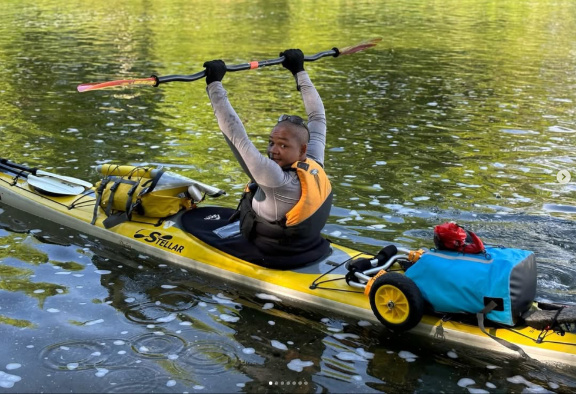
At home on the water. Click the pic to see Mother Water, Devin Brown’s amazing story on film.
Devin Brown: What I’ll say about that is, weather is volatile and when you're spending time with the elements, you never really know what you're going to get. And I never mean to put myself into danger, but that is just one of the risks that happens. I went down river at the end of May last year. So, Memorial Day, things are still cold. We have a rainy season, so the five or six weeks that I spent on the river the majority of it was in rain and inclement weather.
As I was crossing Lake Cass, which is the second important crossing, I'm looking at the sky—because I can read the clouds just as well as I can read the river—and it was already windy. So, I spent a lot of time sort of tacking—that is a sailing technique where you sort of paddle in triangles, if you will, or sharp angles to sort of get against the water and cut through the water and cut through the wind. It’s extra work than just being able to paddle in a straight line.
So, I was already fighting and I stopped on Star Island. And I was like, “Well, maybe I should stop,” but I was already like 75% across that stretch of the river, and I knew another storm was coming. I was like, do you want to be stuck in the middle of this lake within a lake when you know that there is a storm coming?” I did not want to be stuck on this island, so I made a decision. I saw that the fishermen were also still out on the water. And I said, “Okay, like, you're gonna trust the fisherman. If they are still there, you're probably going to be okay. And I also knew that it was the calm before the storm, so I was like, let's just get back in the boat. Let's go. I vividly remember, I called my mom and my son to check in for the day and I went on my way. It is a blue day at that moment. Sky is gorgeous, and I'm going.
I probably have like 20% left of this lake to cross before I can see this little stone dam, and all of a sudden, everything goes black and white. I'm looking around and the fishermen are gone. The wind starts pelting, and I am not exaggerating when I say they were 35 to 40 mile an hour winds pelting down. The lake just looks like a washing machine, and I am just like, I have no options. I'm in the middle of this body of water. All I can do is lift my paddle up and I just started to pray. And I am asking my grandmother for guidance, support and protection at this moment, and I am just—my arms are up in the air. I feel my soul. I always say, like Roger Rabbit, when those little hyenas or whatever they are, when they start laughing really hard and their souls leave their bodies and then they die. My soul was like, I'm out.
And all of a sudden, like it just sucks back into my body and the sky just opens up and it's a blue day all over again. My heart is racing. I'm shaking out. My legs are shaking, and I have to keep paddling. Like what are my other options? I'm in the middle of a lake in the middle of the Mississippi River. I have to paddle. I have to get off the water, which means that I have to paddle. I approached this little rocky dam that they have there to try to keep the water levels up, and it was high enough that I could just bubble over it. I was just like, if I get out of this boat ,I'm not getting back in this b---h. I just had to bump over this little damn and keep paddling because if I got out of the boat that day, I wasn't getting back in.
So, that's actually a lot of the ways that I handle a lot of things with life now. I'm like, hey remember that time on Lake Cass, you died—because I literally died. It was a moment of rebirth. I’m like, this is nothing compared to that time where you felt your soul leave your body; or this is nothing like that time where you are coming out of the Cooke Dam and the undercurrent caught the bottom of your boat and you almost capsized and you felt like the hand of God was pushing you back up upright. Or it's nothing like that time where you were in the middle of the river, and there is just a blue patch over you. But there was thunder and lightning ahead of you and behind you. And the only thing that I could do was paddle at the right pace to stay in that blue patch because I had nowhere to go.
Zakiyyah Ali:
Wooow!
Devin Brown: There are lots of moments like that. The upper Mississippi River is comprised of 26 dams; they're what they call the pool, and I have to navigate through all of those. One time, one of the Army Corps engineers parked a barge during high water, on the other side of the dam. I didn't realize that I had jammed my rudder, which helps me control my boat. I was in the lock, because the water was high. I was sort of bumping around and my rudder hit the lock wall, so it wasn't working. When you' re coming out of the lock, it's like a canal and they've got these pillars that the barges can tie onto. I have probably like six feet of space between the barge and the pillar to navigate through while the dam is throwing all these different kinds of currents.
And I have no rudder.
Which I don't realize until it's almost too late, and I have to do something. I have to maneuver my body and my paddle in just enough way so that I don't get sucked back into the dam. All of this sounds really horrifying, but worse things happen on land. Those moments that you just get jarred in your everyday life are no different than what happens on a river. You still have the skill set and the ability to navigate through those tough moments in life, and my practice on the river just reinforces that I had the skill set to handle whatever is thrown at me.
Zakiyyah Ali: You started by saying you are an ultra endurance kayaker. What kind of training do you do for this activity?
Devin Brown: There's no better training than paddling itself. Because I live in Minnesota, I don't get to paddle all year round. This year specifically ,as I have crossed over into my 40s have realized that I can't just wing it as much as I used to. So I've been in the gym three to four days a week lifting weights. I'm going to start doing some cardio after this race, after I can sort of see what my strengths and my weaknesses are, and I can make those adjustments.
Weight lifting, cross body, lower body. I was also doing some rehab work, because in 2023 I got into a car accident, and I ended up herniating my L5 and my S1. Often I re-injure my back and I have to re-strengthen. It's like I have to start from the beginning every couple of months, because I hurt myself again, because I’m still within those first five years of the car accident.
I know you have an ultimate goal, and what is that?
Devin Brown: You know, my ultimate goal was to be the first Black woman on record to solo the Mississippi River. I made it one thousand twenty five miles in 2024. I have said out loud that in 2028, I will do a re-attempt down the river to get to the Gulf of Mexico, all 2300 miles. But honestly, my ultimate goal is to continue to create safe spaces for people of color to engage with water, to become water stewards, to find the mental calm that happens when we engage with water, the homeostasis that's possible, the spirituality, the mental clarity, all of those things let you get over the fear that comes with doing outdoor activities.
I really want to see more Black people on the water. I want to see more Black people out in nature, reconnecting to the lands that we’re made of. Yeah, we're all made of the same things as the trees and the grass are made out of, and it's important that we coexist with them for our mental health, for our well-being. And we just don't do that enough because of the stresses of life and capitalism and all of that s--t. I think if we could just tune in to Earth, we would really see what is important. It's not money. Yes, we need money to do things. Like, what if we didn't need money to do things? What if what if we all just listened to the Earth and figured out a better and a different way to live?
There's no way that we were put here to have to go to work for 30 and 40 years to pay banks to buy food that grows from the Earth. There's no way—this is all made up, and I think that if we all connected to nature—which is also why they keep us away from nature—you would hear intuition and you'd realize that we're meant to be frolicking and playing in rivers and chasing waterfall. I didn't mean to quote TLC, but that's how it came out. You know, being close to God is playing and being in nature. I think that seeing people like myself and other explorers or adventurers of color doing the thing and foraging and learning the Earth and taking off our shoes, we'll all be better for it.
Zakiyyah Ali: I commend you, my sister. In reading and learning about you I did a little dive, just barely scratching the surface of what this industry of paddling, kayaking and canoeing is worth.
These vessels and the paddles and the gear … it’s not a cheap hobby.
Devin Brown: It's not a cheap hobby, but I'll tell you why it's not. It’s not a cheap hobby because, out of all of outdoor recreation, only about 0.6% of people are engaging with water in that way. A lot of these companies are struggling because they can only make so much money, because there's only so much of a demand, and it costs a lot to make these products. That is really part of the reason why it's so inaccessible. If more people were buying PFDs [personal floatation devices], it just like anything—supply and demand—the cost would go down.
Zakiyyah Ali: I was very amazed, just looking at what things are. And so, I thank you. So now, tell us a little bit about what you were doing in your home state and all for this cause. You started organization?
Tell us a little bit about what you were doing in your home state for this cause. You started organization called Sovereign Waters, correct?
Devin Brown: I did. My work doesn't limit me to the Mississippi River or the state of Minnesota. It brings me to places like Alabama, where I can join sacred spaces and get people on the Black Warrior River. As a partner with the Mississippi Watershed Management organization and Sankofa Swim International, we're going to start doing pool to river sessions, which is a gradual process of getting folks more familiar and comfortable with the water.
Then it's accessible and people can deal with their fear of water. Many Black folks have a fear of water because of segregation and public swimming pools closing, and no access to water. There is a town on the west coast of Africa where people don't go to the beach because hundreds of years ago, their relatives would go to the beach and never return, because of the transatlantic slave trade.
Zakiyyah Ali: Yes.
Devin Brown: Black people are doing the work all over the globe of getting rid of this fear of water. Yeah. We just heard the call and we're just answering what the water has told us to do.
Zakiyyah Ali: If people want to be in contact with you and all your organization, how would they do that?
Devin Brown:
There's contact information listed on the website and I'd love to talk.
Zakiyyah Ali: Okay, I've appreciated your time and your energy, your enthusiasm, your stories. And in parting, is there anything else that you would like to share or tell people about you and this experience, what you do?
Devin Brown:
You know, life is too short to work for someone else and to have fears. So, Carpe Diem!